
I recently listened to a Masters of Scale podcast on relational intelligence — the idea that emotions, relationships, and the ability to understand people are not distractions from work, but part of how good work gets done.
This resonated with me.
I have always thought of emotion as the seed and systems design as its carrier. Emotion tells me that something matters. Rational thought tests that instinct; systems design gives it structure, durability, and scale.
But this is not a post about leadership. It is, rather, another post about AI.
Hear me out.
For a long time, one of the prevailing orthodoxies for work was to operate within constraints.
Get in. Do the work. Get out.
Keep the personal and professional separate. Leave your emotions at home. Maintain work-life balance by dividing yourself into two cleanly isolated environments — almost like separate runtime sandboxes.
I have never found this idea particularly persuasive. Why would one wish to live a Severance of one’s own making?
When we improve at work, we are improving a version of ourselves. If that improvement cannot travel into the rest of our lives, then our learning becomes fragmented. Our growth becomes local to one environment.
And if being yourself prevents you from doing the work expected of you, perhaps the absence of an emotional escape hatch is useful information. Perhaps it gives you the foundation to find something where you do not have to amputate the parts of yourself necessary for judgement, meaning and good work.
For most of the history of computing, however, the machine furnished a powerful counterexample.
Computers were deterministic. Soulless, perhaps, but dependable.
Given the same input, they produced the same output. Engineering was largely the discipline of reducing ambiguity — accounting for every edge case, traversing every possible path, and constructing one sufficiently comprehensive algorithm to rule them all.
Human preference was noise. Emotion was imprecision. Taste was an unruly residue to be transmuted into requirements before the real work could begin.
Then we built machines that make mistakes.
We now routinely use computers whose answers are probabilistic, inconsistent, and occasionally spectacularly wrong. And despite all this, we are doing as much with them as before — probably more.
We have learnt to work with machines that require judgement. This changes something fundamental about (software) engineering.
Not everything needs to be expressed as a rigid framework. Not every problem needs a deterministic outcome. Not every possible reality needs to be simulated before useful work can begin.
Choice matters. Preference matters. Taste matters.
And, increasingly, emotion matters.
AI systems do not merely process instructions. They interpret intent.
When a human says, “Make this clearer”, there is no objectively correct result. The system must infer what the person values — brevity, accuracy, warmth, forcefulness, elegance, familiarity, or something else entirely.
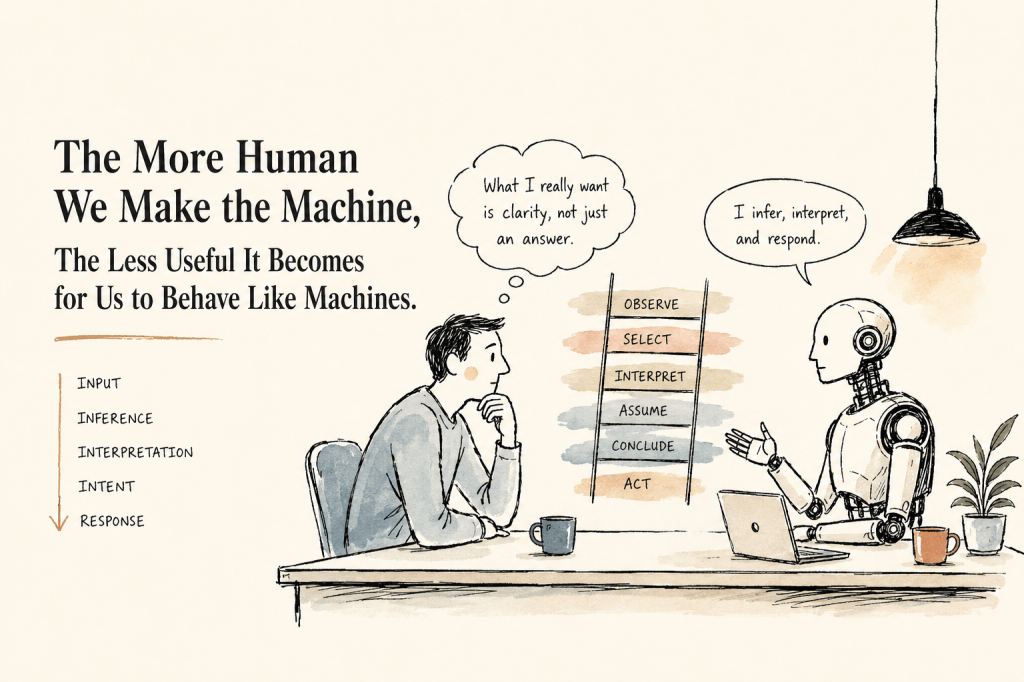
The response is produced by climbing a ladder of inference: observing what was said, interpreting what it may mean, inferring what the person wants, and choosing an appropriate action.
Humans do this constantly with one another. Now machines are beginning to participate in the same loop.
This means “expression” is becoming part of the technical interface.
A person building an agentic system cannot think only about workflows, tools, and execution graphs. At some point, they must decide how the system should interpret people, how it should express uncertainty, how it should respond to frustration, and what kinds of behaviour feel acceptable to a human being.
Even the most mechanical agent eventually reaches a human boundary.
And on the other side, humans using these systems must learn to express themselves with greater fidelity.
What do you actually want?
What feels wrong about the current result?
What trade-off are you unwilling to make?
What does “better” mean here?
These are not merely prompting techniques. They require self-awareness. You cannot communicate your preference precisely without first recognising that you have one.
As machines become capable of interpreting language, ambiguity and preference, the parts of human thought that were once excluded from technical interfaces — judgement, taste, values, emotion and relational understanding — become increasingly important inputs to work.
Expression has always been a form of information. In the age of AI, it is also becoming a form of programming.
This engenders a peculiar self-reinforcing loop.
Builders are attempting to embed simulated emotional intelligence into machines. Those machines consequently work better when humans interact with them as emotional beings.
The more human we make the machine, the less effective it becomes to behave like a machine ourselves.
For decades, people were told to bring a sanitised, rational, emotionally flattened version of themselves to work because that was the version most compatible with the systems around them.
Those systems are now changing.
AI can absorb ambiguity. It can negotiate preference. It can work with incomplete articulation and iteratively move towards intent. It can respond not only to what we say, but to how we react to what it produces. Precisely because machines can imitate emotional qualities, we must become better at distinguishing genuine understanding from persuasive simulacrum.
This does not make emotions infallible. It does not mean every feeling should become a decision.
It means emotions are no longer merely an inconvenient input to be expunged before serious work begins. They are part of the signal.
The future of work may therefore demand something quite different from the industrial ideal of the professional human.
It may reward people who understand what they care about, can express it accurately, and can combine that emotional clarity with rational thought and systems design.
A large body of decision research shows that emotions systematically affect judgement — sometimes beneficially and sometimes harmfully. Anger, fear, sadness and enthusiasm do not merely reveal preferences; they can distort probability estimates, risk tolerance and interpretation. The answer, then, is not simply less emotion, but greater emotional clarity and resilience — shaped through real feedback loops.
Emotion and reason are not mutually exclusive in this new world.
If ever there was a time to bring more of yourself to work, it is now.
The robots can handle being robots.


Leave a comment