
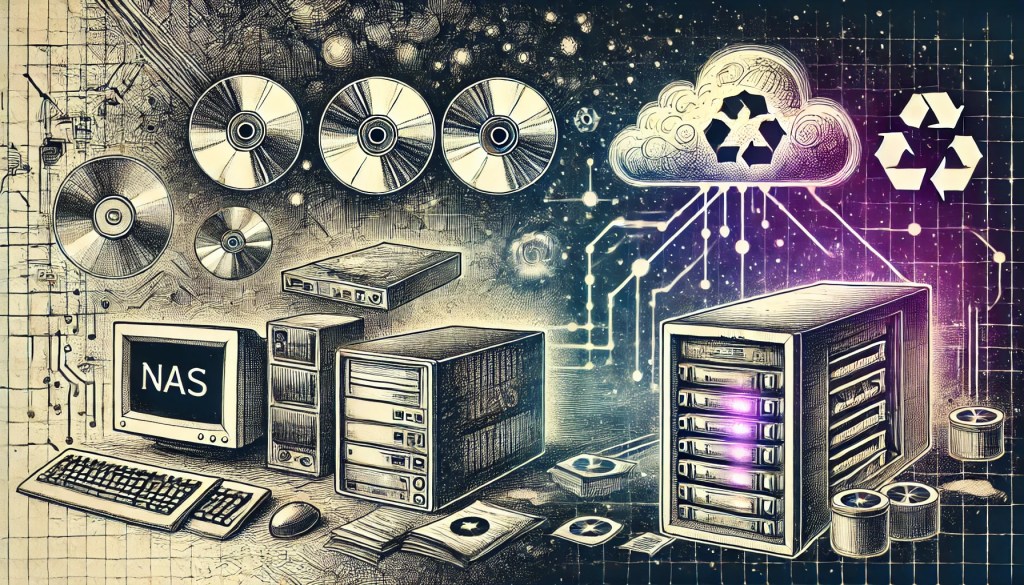
In the quiet hum of technological progress, a peculiar shift has occurred — our sense of self, once rooted in physical places and tangible artifacts, now expands into the digital realm. As an ’80s kid, I lived through the waning years of an Internet-less world, where mementos of our existence were physical and stories of our exploits were recounted by family or preserved in photo albums.
Today, much of our presence, our identity, resides in digital bits — posts, blogs, Netflix histories, and cloud backups. For makers and creators like myself, this shift is even more pronounced. The artefacts of my existence are as much digital as they are physical. They reflect who I am, what I’ve built, and what I aspire to preserve.
Yet, the digital realm is fragile. Cities and civilizations have perished, their physical legacies lost to time. Digital ones and zeros are even more transient — subject to hardware failures, software obsolescence, and the whims of service providers. What, then, is the role of preservation in an era where our creations and memories are stored in the ether?
My journey began in 2004, driven by a tinkerer’s spirit and a desire to keep my creations intact. Back then, cloud services like Flickr and Blogspot were nascent, and storage was a constant challenge. CDs and DVDs were my saviours, painstakingly organised with a homegrown software that tracked changes and backups. The program worked by extracting and categorising updated files and using Nero Burning ROM’s DLLs to burn them to rewritable DVDs. It even tracked backups with an MS Access database stored on the disc itself.
Despite its cleverness, this solution was limited. Discs failed or degraded over time, and accessing archives was cumbersome. I realised the need for a more robust system — one that could adapt to my growing digital needs without constant tinkering.
World of Network Storage
In 2004, I took my first steps into Network Attached Storage (NAS) by repurposing an old desktop with Ubuntu 4.10, the first-ever version of Ubuntu. Setting it up was an adventure — from wrestling with unobtanium drivers for an Intel 815 chipset to installing Samba shares on two mismatched hard drives. This makeshift NAS was powered by a gigabit PCI network card and consumed a hefty 150 watts when paired with its CRT monitor.
The result was transformative. With tools like rsync and RoboCopy, I automated backups, synced photos from Flickr, and mirrored key directories. For the first time, my digital life felt organised and accessible. But it wasn’t without its challenges. When a file system corruption struck, I spent three sleepless days recovering data using tools from the Ultimate Boot CD. This ordeal reinforced the need for redundancy.
Hardware RAID was impractical at the time, so I adopted a simpler approach: periodic rsync jobs between two hard drives. In 2006, FreeNAS entered my life, introducing me to ZFS and the world of advanced file systems. Although FreeNAS was rudimentary and buggy, it marked the beginning of a deeper understanding of data integrity, redundancy, and system resilience.
Upgrading to RAID 1 was a watershed moment. Despite the challenges of configuring GEOM on FreeBSD, I managed to create a mirrored setup with the help of borrowed drives. This experimentation extended beyond storage, inspiring my computer science project: a Windows package manager inspired by Linux’s APT (and funnily Microsoft later released a namesake for Enterprise Deployment Management.)
But FreeNAS wasn’t foolproof. A routine upgrade in 2007 corrupted the file system, leading me to briefly switch to Windows Home Server (WHS) and its Drive Extender feature. WHS’s performance was sluggish on old hardware, and its limitations soon drove me back to FreeNAS, which had matured significantly by 2009 with better ZFS support.
By 2015, cloud services like Digital Ocean were mainstream. I migrated many of my projects and backups to the cloud, hosting web applications and using droplets as replication targets for rsync jobs. This setup worked seamlessly until a missed payment led to the abrupt deletion of my data. While local backups mitigated the loss, the metadata and configurations tied to those services were irretrievably gone.
This incident taught me a valuable lesson: even the most reliable cloud services are not immune to failure or oversight (considering decade-scale timelines.) It underscored the importance of maintaining control over my data and reaffirmed my commitment to local backups.
Commercial NAS
In 2016, I purchased a WD MyCloud EX2 Ultra equipped with two WD RED 2TB drives. This marked a shift from makeshift solutions to a dedicated, plug-and-play NAS. Its simplicity and reliability were a breath of fresh air after years of tinkering. It served as my primary storage solution, safeguarding everything from personal projects to photos and critical files. For eight uninterrupted years, this NAS ran continuously, ensuring that my data remained safe and accessible.
In 2023, however, the limitations of this setup became evident. One of the drives failed a S.M.A.R.T test, prompting an urgent need for replacement. Simultaneously, storage demands had grown beyond the initial capacity, with years of additional data from photos, backups, and media libraries pushing the system to its limits. These challenges led me to explore more scalable and robust options.
After thorough research, I upgraded to a Synology DS923+, paired with two Western Digital 10TB Ultrastar drives. The Synology DS923+ offered key features that addressed my long-term storage needs, including support for future drive expansions and advanced backup features through Synology’s software ecosystem. Its power-efficient operation and tailored design for 24/7 usage made it a worthy successor to the WD MyCloud EX2 Ultra. Your mileage may vary though!
The transition was smooth. Migrating data, setting up redundancy with RAID configurations, and utilising tools like Hyper Backup provided a significant upgrade in data security. With the ability to connect to external expansion bays, this system feels future-proof, capable of accommodating growth for the next decade or more.
This evolution from a modest WD MyCloud to a high-capacity Synology NAS encapsulates two decades of lessons:
- Hardware should be purpose-built for 24/7 operation.
- Software should prioritise stability over features.
- Redundancy is non-negotiable, encompassing local backups, offsite copies, and cloud replication.
- Scalability ensures longevity, making future upgrades seamless and cost-effective.
- Above all, do not forget the compounding effect — every decision you take, has to endure a decade and then endure the transition to the next.

This journey through decades of NAS solutions is more than a technical tale. It’s a meditation on what it means to exist in a digital world. As creators, our data — our work, our memories — becomes an extension of ourselves. Preserving it isn’t merely about safeguarding files; it’s about honouring the lives we’ve built, the stories we’ve told, and the connections we’ve made.
Yet, as much as we seek permanence, we must also embrace impermanence. Digital or physical, what we create is transient. The act of creation, the learning it brings, and the legacy it leaves behind are what truly endure.
So, as I look at my Synology setup, humming quietly in the corner, I see not just a storage solution but a testament to two decades of growth, learning, and the philosophical pursuit of preservation in a fleeting digital world.
 Shamasis Bhattacharya
Leave a comment