Just one more day of school. As I wish myself good luck, I begin my journey. My school, Don Bosco School Liluah, nestles in Liluah, merely five kilometres from Howrah Railway Station, located within Howrah, in the heart of West Bengal, India.
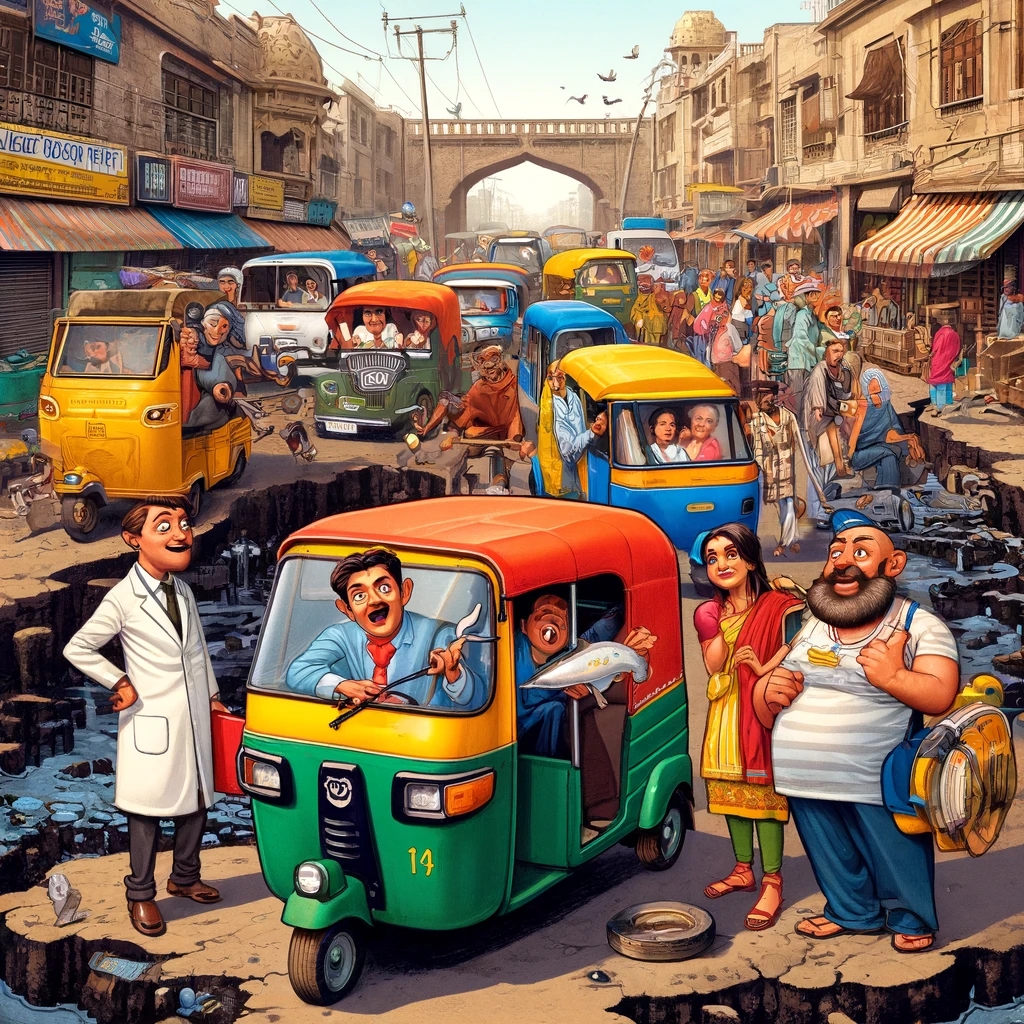
Crossing the expanse between Howrah and Liluah is no mere commute; it transforms into an adventure sport with a diverse group of non-congruent participants. The thrill is further amplified by the choice of transport — an auto rickshaw. I am among those fortunate souls who dare to take this ‘devil’s own’ mode of transport to reach school, twice a day, five days a week — an epic daily journey.
The adventure begins as the morning sun casts its warm, affectionate rays on a line of autos waiting to spring to life. Igniting the engines of these modern-day dinosaurs is nothing short of Herculean. A couple of kicks are rarely sufficient; it takes numerous attempts, exerted with raw brute force, to awaken these beasts. No wonder auto drivers boast formidable muscles! The newer models, although easier to start, falter under the strain of Howrah’s convoluted, pothole-riddled roads, leaving only the sturdy, prehistoric models as survivors. It’s almost as if evolution decided to take a u-turn on it’s way to Howrah – riders needing more muscle than the horse it rides!
The ordeal doesn’t end with starting the engine. Autos are packed so tightly that navigating out of the parking lot is an arduous challenge. It is like salt crystals structured as a crystal lattice. After a series of bumps to the auto behind and in front, the escaping auto finally squeezes out, joining another queue, awaiting passengers to embark on this rugged flight.
On approaching the auto, one beholds its grand interiors, meriting a description akin to that of a Mercedes Benz E-Class. The handrails and iron backrests, cloaked in a ‘patina’ of rust, offer a fascinating sight. Leaning against these handrails reveals the stubborn, ‘never-say-die’ rust marks, challenging anyone tempted to rest their weary back. For insights on rust removal, one might consult our teacher, Mr. Shantanu Bandopadhyay, a seasoned expert in the field.
From handrails, we transition to the pragmatic seating. The regal seats are made from exquisite hard wood boards cloaked in tarpaulin, perfectly demonstrating Newton’s Third Law. The seat presses back with equal and opposite force! The mud-stained curtains, holey roofs, and greasy floors further contribute to the unique charm of Howrah’s autos.
Besides school students, there are other attractive commuters like fishmongers and garage-workers who also avail the services of these celebrity autos. A fishmonger occupies his seat with a distinct air of pride, owed largely to his ‘aromatic’ companions causing fellow passengers to give him a wide berth. Occasionally, one may see a couple of fishes peeping out of their container, also trying join the seating algorithm! A garage worker, marked by grease-stained clothes, ensures his presence is remembered through the dark imprints he leaves on the seat and handrails, which invariably transfer onto our pristine ‘Ujala-White’ uniforms, allowing us to carry forward memories of our fond interactions straight on to our school furnitures.
“Size does not matter” is the watchword for all auto drivers. No matter how small the auto is, there always seems to be room for an infinite number of passengers to fit in. Their unwritten constitution states that a minimum of seven passengers must sit in order to begin the journey. The passengers are strategically positioned –– three beside the driver, three behind and one more on a specially designed ‘luxury’ seat. This special seat is a grand extension of the toolbox in the rear leg-space. In this regard, the auto drivers are better space savers than most of our modern interior designers. Though one can’t help but feel sympathy for anyone relegated to the ‘luxury’ seat, with its intrusive sharp edges. I recall that day when an elderly woman felt it was “God’s will” to sit on this seat. It was just after a minute’s journey that the seat collapsed and what happened next is best left unsaid.
Now, with passengers stuffed like hens in a coop, the vehicle makes a wild lurch forward. Anyone familiar with camel rides would find a kindred spirit in the auto ride. The usual route is through the Grand Trunk Road. A close inspection of the road would reveal that it was first laid by Sher Shah Suri, some 500 years ago, riddled with exposed stones and resembling the uneven terrain of ancient civilizations more than a modern roadway. It may even be that the roads of ancient cities of Mohenjo Daro and Harappa were better than this! The driver meticulously avoids the frequent craters on the road, which are evidences of the great excavation works jointly undertaken by the Howrah Municipal Corporation, Calcutta Telephones and Calcutta Electric Supply Commission. We may soon expect the autos of Howrah file a patent as a cure for ailments like insomnia and indigestion!
As the journey proceeds, one can see the helpless traffic police at the next bus stop after Howrah station. As per rules, no lorry can travel through Howrah during the day. However, on our way we are very often stopped by frustrated lorries trying to either get in or out of a lane, reminiscent of our classmate Debraj Chatterjee trying to manoeuvre through classroom desks. No Parking signs and one-way signals decorate the roads, intended only for those who can read them. Parked cars, lorries and rickshaws occupy over two-thirds of the road. Other than these, the rest of the available space is crowded with pedestrians, cycles, hand-pulled rickshaws and hawkers. In this scenario, the horns of the autos emerge like the weapon of Brahma. The peculiar croaking sound remains permanently switched on. It is very effective in clearing vehicular traffic, pedestrian congestion and as well as the numerous bulls and cows meandering about. Other than them are a huge number of cats, dogs, giant mosquitoes and other big and small creatures living in harmony with the ever-tolerant human population of Howrah. Who said animals dwell only in forests?
On both sides of the road, open drains substitute for footpaths. These drains are clogged throughout the year and the whole area turns waterlogged during the rainy season. There is a continuous convection cycle with debris from these drains cleared and kept right beside the drains on the road, only to be washed back into the drains by mother nature. Even during summer, parts of the road remains wet due to overflowing drains. And our multipurpose all-terrain vehicle crosses this ocean in rain or sunshine.
Drivers, skilled in manoeuvring through chaos, also possess a rich lexicon of expletives, which serves as a vocal alternative to horn honking. Most conversations among auto drivers consist of either cursing the traffic or arguing with irate passengers, warranting a degree of censorship for the uninitiated.
Regarding pollution, these autos had undergone their sole emission test when they were manufactured some decades ago. Neither the Howrah Auto Association nor the Howrah Police pay any attention to this issue. An interesting part of the affair is that the engines of these autos are located under the driver’s seat and most have a defective silencer pipe. This leads to an interesting phenomenon; whenever the autos are stationary with their engines running, the smoke emerges from under the driver’s seat and the whole auto is engulfed with smoke — somewhat acting as a privacy screen obscuring visibility to the occupants of the vehicle. From outside it seems as if the auto is on fire. Then again, when the auto is in motion, thick black clouds of smoke spew out from behind the auto — just like the trails left behind by high-flying jet planes and doubling as an effective insect repellent.
As the journey culminates, I disembark, momentarily feeling as if I’ve just returned from a gravity-free space mission. On my trusted legs, I approach the school gates, reflecting on how these autos, much like the trams of Kolkata, are a definitive heritage of Howrah.
Originally published: The Statesman, April 17th 2003

 Shamasis Bhattacharya
Leave a comment